

Professional Muskrat Removal in Milwaukee, WI
If you notice muskrats in your pond or stream, it’s important to take prompt action. Muskrats can cause significant property damage by burrowing into shorelines, which can weaken banks and compromise their structural integrity. Advanced Wildlife and Pest Control specializes in professional muskrat trapping and removal in Milwaukee, Wisconsin. Our certified wildlife removal specialists have the experience and equipment needed to safely trap and remove nuisance muskrats from your property.
Keep Muskrats Out of Your Pond!
Get rid of muskrats with our animal control and exclusion services in Milwaukee, Wisconsin.
Give Us a Call Today!What are the Signs of a Muskrat in Your Pond?
Muskrats prefer habitats near water and rely primarily on aquatic plants for food, showing no interest in human homes. They burrow into pond and lake shorelines, creating den entrances that are typically five to six inches in diameter and located about six inches below the water’s surface. Common signs of muskrat activity include floating vegetation, muddy or cloudy water, collapsed or weakened banks, and pellet-sized droppings on rocks along the shoreline.
- Raccoon Identification -
What Does a Muskrat Look Like?
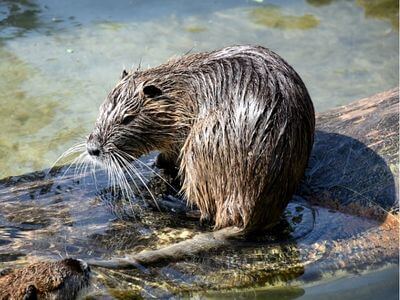
Muskrats are semi-aquatic rodents with glossy brown fur, weighing between 2 and 4 pounds and measuring about 2 feet in length, including the tail. They are strong swimmers, equipped with partially webbed hind feet and a long, scaly tail that acts as a rudder in the water. Muskrats are often mistaken for beavers, but they are much smaller and lack the large, flat tail characteristic of beavers. They have small eyes and ears, short front legs with sharp claws for digging, and longer hind legs adapted for swimming.

Muskrat Damage & Diseases
Muskrats generally pose little threat to people but may bite or scratch if they feel threatened. They can carry tularemia, a disease that may be transmitted to humans through contaminated water and can cause symptoms such as fever, chills, headaches, muscle aches, and diarrhea. A greater concern is their burrowing behavior, which can damage banks, waterways, and retaining walls. Over time, this damage may lead to erosion, increased flooding risk, and property damage.
Muskrat Prevention
Exclusion techniques and habitat modifications can be used to discourage muskrats from inhabiting certain areas. Installing stone riprap, wire mesh, or other protective barriers along pond embankments can help prevent muskrats from burrowing into shorelines. Additionally, trimming and maintaining overgrown vegetation reduces available food sources, making ponds less attractive to muskrats.
- Muskrat FAQs -
Frequently Asked Questions
What do muskrats eat?
Muskrats primarily eat aquatic plants like cattails, lilies, and rushes. Muskrats may also occasionally eat mussels, frogs, salamanders, crayfish, small fish, and snails.
Where do muskrats live?
Muskrats inhabit ponds, lakes, marshes, slow-moving streams, and lakes with still, shallow waters. They burrow into the banks of ponds or streams or form dome-shaped lodges out of leaves, sticks, and mud. Lodges can be up to eight feet wide and five feet high. Muskrats can also be found in drainage ditches and retention ponds.
When do muskrats have babies?
Muskrats mate from March to September. After a gestation period of about one month, female muskrats give birth to three to six young per litter. Muskrats have two or three litters per year. Young are capable of swimming at three weeks of age and will be weaned by the time they are a month old.
How long do muskrats live?
Muskrats have a short lifespan. Most do not make it through their first winter. Flooding is a major cause of death among young muskrats. Mink, foxes, raccoons, coyotes, hawks, owls, snakes, and snapping turtles prey upon muskrats.
What does muskrat poop look like?
Muskrat droppings are black to dark green, cylindrical, and about half of an inch long. Muskrats use latrine areas along shorelines to defecate, such as stumps, logs, or rocks along the water.
What do muskrat tracks look like?
Muskrat tracks are small with long, finger-like toes. They have five toes on each foot, but the front inner toe is so small that it does not usually appear in the front prints. Footprints are about 2 to 3 inches long. There is often a visible tail mark in between the footprints. Muskrat tracks are often found in mud or sand along shorelines near water.
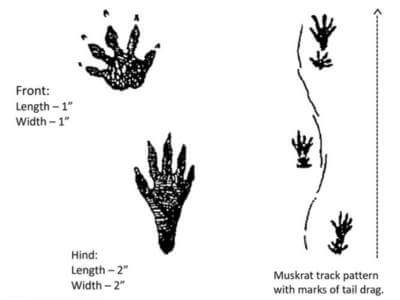
Illustration by Dan Goodman