

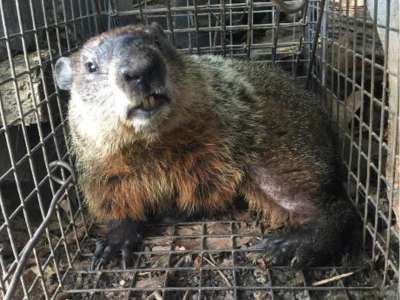
Professional Woodchuck Removal in Milwaukee, WI
Advanced Wildlife and Pest Control provides wildlife removal and exclusion services for woodchucks and groundhogs in Milwaukee and southeastern Wisconsin. Our certified wildlife specialists safely and efficiently trap, remove, and exclude nuisance wildlife from homes and businesses.
We will perform a thorough home inspection to identify signs of activity, such as denning sites, burrows, and vegetation damage. Our team then sets live traps to humanely capture the groundhog. Once the groundhogs are removed, we can seal entry points to prevent future wildlife intrusions. Live trapping is the most effective way to remove a groundhog.
Keep Woodchucks Out of Your Yard!
Get rid of woodchucks with our animal control and exclusion services in Milwaukee, Wisconsin.
Give Us a Call Today!What are the Signs of a Woodchuck in Your Yard?
Woodchucks are diurnal animals, most active in the early morning and late afternoon. These voracious herbivores feed on a wide variety of plants, including lettuce, broccoli, beans, and cantaloupe, often causing significant damage to gardens and flowerbeds. Woodchucks also dig extensive burrow systems beneath decks, patios, driveways, and sheds. Over time, their burrowing can weaken building foundations and even threaten the stability of structures.
- Woodchuck Identification -
What Does a Woodchuck Look Like?
Woodchucks, also known as groundhogs, are large burrowing rodents with a flat head, a rounded nose, short legs, and a bushy tail. Their fur is typically yellowish-gray to brown, and they weigh 7 to 14 pounds, measuring about 2 feet long, including the tail. Equipped with long front claws and sharp, chisel-like teeth, woodchucks are expert diggers, creating complex, multi-chamber burrows. Unlike most mammals in Wisconsin, woodchucks are true hibernators. They fatten up during the summer and spend the majority of winter sleeping safely underground.

Woodchuck Exclusion
The most effective way to prevent woodchucks and groundhogs is through exclusions and habitat modifications around your property. Our heavy-duty mesh fencing is designed to keep woodchucks out from under decks, porches, and sheds. To prevent burrowing, we bury the fencing 12 to 18 inches deep into the ground. Another key prevention strategy is to remove potential food sources, such as garden plants and vegetation that attract these rodents.
- Block access underneath decks, porches, and sheds.
- Put up a barrier around your flowers and garden to keep them out.
- Remove woodpiles and other places where woodchucks nest.
- Woodchuck FAQs -
Frequently Asked Questions
What do woodchucks eat?
Woodchucks eat grasses, clover, dandelions, alfalfa, ferns, and flowers. They can be destructive to lawns, vegetable gardens, and other landscaping. They will eat peas, beans, corn, carrots, lettuce, apples, berries, and other garden crops. Woodchucks can eat up to a pound and a half of vegetation per day. They also eat insects, such as grasshoppers and snails.
Where do woodchucks live?
Woodchucks are found throughout Wisconsin. They primarily live in underground burrows in crop fields, meadows, pastures, and wooded areas with abundant food sources. As diurnal animals, woodchucks spend several hours a day feeding above ground before returning underground to their burrow. The burrows can be up to five feet deep and 60 feet long or more. The burrow systems are quite complex, with each containing a main nest chamber, a separate toilet chamber, and additional chambers ground throughout the burrow. Woodchucks are solitary animals except during the eating season. During that time, a male and a female will share a burrow.
When do woodchucks have babies?
Woodchucks mate from late February to April. The gestation period is about one month, with four to five young born in April or early May. Woodchucks have one litter per year. The young are fully weaned around six weeks and begin to look for their own living space when they are two months old. They do not breed until their second year.
How long do woodchucks live?
The average life span for a groundhog in the wild is three to four years. However, groundhogs in captivity can live up to 14 years. Coyotes, foxes, bobcats, weasels, owls, and hawks prey upon woodchucks. Woodchucks are often killed by vehicles because they move relatively slowly.
What does woodchuck poop look like?
Woodchucks defecate in toilet chambers, which they dig underground. If you find droppings on your property, they are likely from another animal.
What do woodchuck tracks look like?
Woodchucks have four toes on the front paws and five toes on the back paws. Their pawprints are about 1.5 inches long and wide. When walking, the tracks are spaced about 4 inches apart, and when running, they are 12 inches apart.
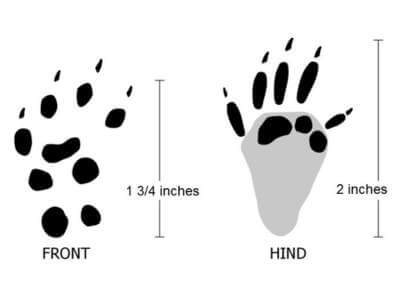
Illustration by Dee Ebbeka