

Professional Raccoon Removal in Milwaukee, WI
Advanced Wildlife and Pest Control provides raccoon removal and exclusion services in Milwaukee and southeastern Wisconsin. Our certified wildlife specialists safely and efficiently trap, remove, and exclude nuisance raccoons from homes and businesses.
We begin with a thorough inspection to identify signs of raccoon activity, such as droppings, nesting materials, tracks, and entry points. Our team then sets live traps to humanely capture raccoons. Once the raccoons are removed, we can seal entry points to prevent future wildlife intrusions. Live trapping is the most effective way to remove a raccoon.
Keep Raccoons Out of Your Home!
Get rid of raccoons with our animal control and exclusion services in Milwaukee, Wisconsin.
Give Us a Call Today!What are the Signs of a Raccoon in Your Attic?
Female raccoons frequently seek out warm, sheltered spaces like attics, chimneys, and garages, especially in the spring, to raise their young. These agile climbers can access homes using overhanging tree branches and downspouts. With their strong, dexterous front paws, raccoons are capable of tearing through soffits and roof vents to make their way inside. One of the most noticeable signs of a raccoon infestation is noise, particularly at night. Homeowners often hear scurrying, thumping, or scratching sounds coming from the attic as raccoons move around.
- Raccoon Identification -
What Does a Raccoon Look Like?
Raccoons are easy to identify by the distinctive black “mask” of fur around their eyes and their bushy, ringed tails. Their coats are typically grayish-brown, and they usually measure 2 to 3 feet in length. Adult raccoons generally weigh 10 to 20 pounds.
They have stocky bodies, rounded ears, narrow snouts, and short legs with flat feet. Because their hind legs are slightly longer than their front ones, raccoons often appear hunched when they walk or run, giving them their characteristic waddling gait.

Raccoon Damage
Raccoons can cause serious damage to your attic, roof, and yard, resulting in costly repairs for homeowners. These intelligent pests are constantly on the hunt for both food and shelter. Their strong and agile paws allow them to tear off shingles, fascia boards, and soffits to gain access to attics. Once inside, raccoons rip apart insulation to make nests and contaminate it with urine and feces. Additionally, raccoons may dig up lawns while searching for grubs and eat garden vegetables.
Raccoon Diseases
Raccoons can carry diseases and parasites, including rabies, leptospirosis, distemper, fleas, and roundworms. If you are bitten or scratched by a raccoon, you should wash the wound with soap and water and see a doctor as soon as possible. It’s important to avoid contact with raccoons as they can become aggressive when cornered or protecting their young. Even if a raccoon appears calm or friendly, you should never approach a wild animal.
Raccoon Exclusion
Raccoons are a common nuisance for homeowners. These critters often enter yards in search of food, water, and shelter in attics and chimneys. The most effective way to prevent raccoons is to create exclusions and habitat modifications around your home. Our wildlife specialists can identify and seal potential entry points to secure your home and prevent future wildlife problems.
- Secure trash cans.
- Don’t leave pet food outside.
- Install chimney caps and vent covers.
- Trim overhanging tree branches.
- Raccoon FAQs -
Frequently Asked Questions
What do raccoons eat?
Raccoons are omnivores with an opportunistic diet, eating almost anything they can get their paws on. Raccoons feed on insects, crayfish, fish, small rodents, birds, eggs, nuts, seeds, fruits, and berries. In urban areas, raccoons will eat human food and invade trash cans.
Where do raccoons live?
Raccoons are found throughout Wisconsin. They prefer heavily wooded areas with access to trees, water, and abundant vegetation. Raccoons make their dens in hollow parts of trees, brush piles, and abandoned burrows. They are highly adaptable and can also be found in suburban and urban areas, making their homes in man-made structures like attics, chimneys, barns, sheds, sewers, and underneath decks.
When do raccoons have babies?
Male raccoons are polygamous and will mate with several females, while females are monogamous and will usually mate with only one male. The mating season runs from January through March, and gestation lasts approximately two months. The female will raise one litter of three to four young each year. Kits are weaned between two and three months of age. However, young raccoons typically remain with their mother throughout the fall and winter before venturing off on their own.
How long do raccoons live?
The average lifespan of a raccoon in the wild is two to five years. They can live significantly longer in captivity, generally eight to ten years. Raccoons have a few predators, including coyotes, bobcats, foxes, cougars, and domestic dogs. Unfortunately, many raccoons are killed by automobiles or disease.
What sounds do raccoons make?
Homeowners will mostly hear raccoon noises at night. Raccoons are very loud and vocal animals, making sounds like whistling, hissing, snarling, or growling. Baby raccoons are especially noisy and their chirping and whimpering sounds are often mistaken for birds.
What does raccoons poop look like?
Raccoon scat is tubular with blunt ends and approximately 3 to 5 inches long. The color and consistency may vary due to the raccoon's diverse diet. Droppings of many similar-sized mammals are pointed or rounded. Raccoons create latrine sites around trees, logs, rooftops, and attics.
What do raccoon tracks look like?
Raccoons are excellent climbers with strong, dexterous front paws that can pry off shingles, fascia boards, and roof vents to access attics and chimneys. Raccoon tracks resemble a baby's handprint with five toes on each foot. Both front and hind paw prints are similar, but the hind tracks have an elongated heel that sinks deeper into the ground. Raccoons have claws on all of their toes and walk flat-footed. The front and opposite hind tracks will be side by side or close together.
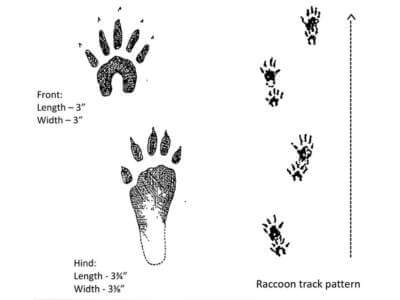
Illustration by Dan Goodman