

Professional Skunk Removal in Milwaukee, WI
Advanced Wildlife and Pest Control provides skunk removal and exclusion services in Milwaukee and southeastern Wisconsin. Our certified wildlife specialists safely and efficiently trap, remove, and exclude nuisance skunks from homes and businesses.
We begin with a thorough inspection to identify signs of skunk activity, such as droppings, foul odors, tracks, holes, and denning sites. Our team then sets live covered traps to humanely capture skunks. Once the skunks are removed, we can seal entry points to prevent future wildlife intrusions. Live trapping is the most effective way to remove a raccoon.
Keep Skunks Out of Your Home!
Get rid of skunks with our animal control and exclusion services in Milwaukee, Wisconsin.
Give Us a Call Today!Skunk Damage & Diseases
Skunks are well known for the strong odor of their spray and their digging habits. When searching for insects, they often leave small holes, 3–4 inches in diameter, in lawns. Skunks can also carry diseases such as rabies, canine distemper, and leptospirosis. Even if a skunk appears calm or friendly, it is important never to approach a wild animal. Skunks can spray humans and pets, which may cause nausea or intense pain if sprayed directly in the eyes.
- Skunk Identification -
What Does a Skunk Look Like?
Skunks have black fur with two distinctive white stripes running down their backs. They are roughly the size of a small house cat, measuring about 2 feet in length, including the tail, and weighing between 4 and 12 pounds. Skunks have small, pointed heads with short ears, bushy tails, and short legs with long front claws for digging. They are most well-known for their ability to spray a strong, pungent odor when threatened.

Behavior & Habits
Skunks are nocturnal, most active at dusk and early morning. They do not hibernate, but may remain inactive for long periods during the winter. Skunks are well known for their unique defense mechanism. Their scent glands produce a strong, sulfur-smelling odor. When threatened, a skunk raises its tail and stamps its front feet. If the threat persists, it twists its body into a U-shape and sprays the attacker. Skunks can accurately spray up to 15 feet, and their scent can be detected from over a mile away.
Solution for Skunk Odor Removal
Mix 1 quart 3% hydrogen peroxide solution, 1⁄4 cup baking soda, and 1 teaspoon liquid soap. Do not add water. This solution can be used to wash skin, clothes, or pets that have been sprayed by skunks. Due to the peroxide, the solution may discolor cloth or lighten the fur of pets. DO NOT use the solution on the pet’s face near the eyes.
Skunk Exclusion
Skunks are a common concern for homeowners, often entering yards in search of food or suitable dens under decks, porches, or sheds. Because skunks are nocturnal, it’s not unusual to notice their odor without ever seeing them. If the smell lingers for several days, you may have a resident skunk that requires removal. The most effective way to prevent skunks is through exclusions and habitat modifications around your home.
- Secure trash cans.
- Do not leave pet food outside overnight.
- Treat your lawn for grubs with our seasonal grub control treatments.
- Block access underneath decks, porches, and sheds with our heavy-duty wire mesh fencing.
- Skunk FAQs -
Frequently Asked Questions
What do skunks eat?
Skunks are omnivores. They prefer to eat insects, particularly grasshoppers, beetles, crickets, and grubs. Skunks eat small rodents, eggs, corn, berries, and other vegetation. In urban areas, skunks may eat garbage or pet food left outside.
Where do skunks live?
Skunks are found throughout Wisconsin. They den in hollow trees, brush piles, culverts, and abandoned animal burrows in wooded areas and meadows. In urban areas, skunks often den underneath porches, decks, sheds, and ditches.
When do skunks have babies?
Skunks are polygamous and mate between mid-February and mid-March. Gestation is about two months. The female has one litter of four to eight young in May or early June. The young are fully weaned by the time they are two months old. The female cares for the young alone. In the fall, the young skunks will venture off on their own.
How long do skunks live?
The average lifespan of a skunk in the wild is two to three years. They can live significantly longer in captivity, generally seven to ten years. Coyotes, foxes, bobcats, owls, and hawks prey upon skunks. Skunks are often killed by vehicles because they move relatively slowly.
What does skunks poop look like?
Skunk droppings look similar to cat droppings but may contain bits of undigested insects, berries, and seeds. Skunk scat is tubular with blunt ends and approximately 1 to 2 inches long.
What do skunk tracks look like?
Skunk tracks look very similar to a cat's, but skunks have five toes, and cats have four toes. Another way to tell them apart is the claw marks. Cat claws are retractable and won’t show up in their tracks. In contrast, skunks have large front claws that are not retractable and leave noticeable nail impressions. The pawprints are about 1.5 inches long and wide.
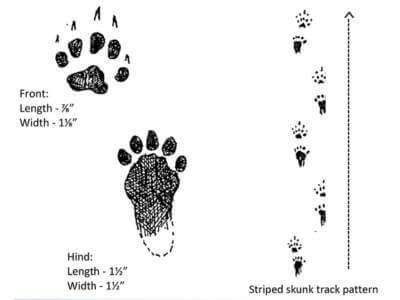
Illustration by Dan Goodman