

Professional Opossum Removal in Milwaukee, WI
Advanced Wildlife and Pest Control provides professional opossum removal and exclusion services in Milwaukee and southeastern Wisconsin. Our certified wildlife specialists safely and efficiently trap, remove, and exclude nuisance opossums from homes and businesses.
We begin with a thorough inspection to identify signs of opossum activity, such as droppings, tracks, and entry points. Our team then sets live traps to humanely capture opossums. Once the opossums are removed, we can seal entry points to prevent future wildlife intrusions. Live trapping is the most effective way for opossum removal.
Keep Opossums Out of Your Home!
Get rid of opossums with our animal control and exclusion services in Milwaukee, Wisconsin.
Give Us a Call Today!Behavior & Habits
Opossums are primarily nocturnal and are skilled climbers. They are generally shy and non-aggressive animals. When threatened, opossums may “play possum,” a defensive behavior in which they mimic the appearance and odor of a sick or dead animal. This response is involuntary and automatic, similar to fainting, and includes drawing back the lips to bare the teeth, foaming saliva around the mouth, and releasing a foul-smelling fluid from the anal glands.
- Opossum Identification -
What Does an Opossum Look Like?
Opossums are small, gray mammals measuring 2 to 3 feet in length, including their tails, and weighing between 6 and 15 pounds. Their fur is white with gray or black guard hairs. Opossums have long, narrow snouts, pink noses, bare ears, and rat-like, hairless tails. Their prehensile tails function like a fifth limb, allowing them to grasp branches while climbing. The Virginia opossum is the only marsupial native to North America. A marsupial is an animal that has a pouch, like a kangaroo.

Opossum Diseases
Opossums can carry several infectious diseases, including leptospirosis, tuberculosis, and tularemia. While they are highly resistant to rabies, they can still carry the virus. Generally docile, opossums often play dead when threatened but may bite in self-defense. Even if an opossum appears calm or friendly, it is important never to approach a wild animal.
Opossum Exclusion
Opossums may look intimidating, but they are actually beneficial animals to have in your yard, as they help control pests like ticks. They are most likely to cause minor problems by getting into garbage or raiding bird feeders. While they rarely cause significant damage, opossums can startle homeowners when they take shelter in wood piles, sheds, or under decks and porches. The most effective way to prevent opossums is through exclusions and habitat modifications around your home.
- Secure trash cans.
- Don’t leave pet food outside.
- Install chimney caps and vent covers.
- Trim overhanging tree branches.
- Opossum FAQs -
Frequently Asked Questions
What do opossums eat?
Opossums are omnivorous scavengers. They eat insects, fruits, berries, earthworms, frogs, plants, ticks, garbage, and carrion. Opossums are often killed by vehicles while scavenging for carcasses along roads.
Where do opossums live?
Opossums are common throughout Wisconsin. They den in hollow tree cavities, brush piles, and abandoned animal burrows in wooded areas near water. In urban areas, opossums often shelter in man-made structures such as sheds, garages, or old buildings. Opossums are typically solitary animals, except when females are raising young.
When do opossums have babies?
Opossums are polygamous and mate in March. Females have one to two litters per year. The average litter size is seven to eight young. Gestation is only two weeks. The female will give birth to underdeveloped babies the size of honeybees, known as joeys. The young will crawl into the mother’s pouch, where they continue to develop. During this stage of their life, they may be seen riding around on the female’s back. By the time they are three months old, they will be weaned and on their own.
How long do opossums live?
Opossums are polygamous and mate in March. Females have one to two litters per year. The average litter size is seven to eight young. Gestation is only two weeks. The female will give birth to underdeveloped babies the size of honeybees, known as joeys. The young will crawl into the mother’s pouch, where they continue to develop. During this stage of their life, they may be seen riding around on the female’s back. By the time they are three months old, they will be weaned and on their own.
What does opossum poop look like?
Opossum scat looks very similar to dog poop. The small, dark pellets are about 1 to 2 inches long. They are smooth on the sides and may be covered in white or yellow mold growth. Fresh opossum droppings are brown in color. The feces tend to be more curly than straight.
What do opossum tracks look like?
Opossums have five toes on each foot. Their opposable toes on their hind feet work like thumbs to help them grab branches when they climb. An opossum’s hind tracks resemble a baby’s handprint. The front and opposite hind tracks will be side by side or close together. If the animal is moving slowly, a tail drag mark may be noticeable, but it typically holds its tail off the ground when walking.
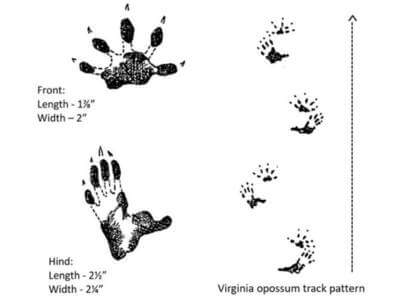
Illustration by Dan Goodman