


Professional Weasel Removal in Milwaukee, WI
While weasels rarely come into conflict with humans, they can pose a serious threat to poultry. If they gain access, weasels may kill chickens, often taking more than they can eat. Advanced Wildlife and Pest Control offers professional weasel trapping and removal services throughout Milwaukee and southeastern Wisconsin. Our certified wildlife specialists safely and efficiently trap, remove, and exclude nuisance weasels from your property.
Quick Links
Keep Weasels Out of Your Home!
Get rid of weasels with our animal control and exclusion services in Milwaukee, Wisconsin.
Give Us a Call Today!Behavior & Habits
Weasels are primarily nocturnal and, except during mating or while raising young, are solitary animals. Despite their small size, weasels are fast, agile, and excellent climbers. They are also surprisingly aggressive and territorial, capable of overpowering animals much larger than themselves. To mark their territories, weasels use a strong-smelling musk released from their anal glands.
- Weasel Identification -
What Does a Weasel Look Like?
Weasels are small mammals in the Mustelidae family, which also includes mink, otters, ferrets, and badgers. They have long, slender bodies measuring approximately 7 to 9 inches in length, with short legs, small ears, and sharp teeth and claws. Wisconsin is home to three species of weasels: the long-tailed weasel, the short-tailed weasel, and the least weasel.

- Weasel FAQs -
Frequently Asked Questions
What does a long-tailed weasel look like?
The long-tailed weasel has brown fur on its back and legs, white or slightly yellow belly fur, and a long black-tipped tail. Long-tailed weasels are 11 to 17 inches long and weigh between 3 and 10 ounces. Their tails are nearly half the length of their bodies.
What does a short-tailed weasel look like?
The short-tailed weasel, also known as the stoat or ermine, has brown fur on its back and legs, white belly fur, white feet, and a short black-tipped tail. They are 8 to 12 inches long and weigh between 2 and 5 ounces.
What does a least weasel look like?
The least weasel is the smallest of all weasels, measuring 6 to 7 inches long and weighing 1 to 2 ounces. The least weasel has brown fur, except for the white belly fur. Unlike the long-tailed and short-tailed weasel, the least weasel does not have a black-tipped tail.
What do weasels eat?
Weasels are carnivores that mainly prey on mice, squirrels, chipmunks, rabbits, rats, and chickens. Weasels will often kill more than they can eat and store the prey for later.
Where do weasels live?
Weasels prefer to live in wooded areas near water. Long-tailed weasels live on farms, and least weasels live in more open areas like meadows and grasslands. Weasel dens are usually found in rock piles, hollow logs, tree stumps, or burrows dug by other animals.
When do weasels have babies?
Weasels mate in late summer, and the young are born the following spring. Females have one litter per year with four to six kits. The female cares for the young alone. The young are fully weaned at six weeks of age and leave to find their own territories when they are just 11 to 12 weeks old.
How long do weasels live?
The average lifespan of a weasel in the wild is about 2 to 4 years. Weasels have a few predators, including mink, hawks, owls, snakes, and other weasels.
What does weasel poop look like?
Weasel scat is usually one inch long, and tapered at both ends. The poop is dark, thin, and twisted. It may contain small bones, fur, or insect parts. Weasels often deposit their scat on logs or rocks.
What do weasel tracks look like?
Weasels have five clawed toes on each paw; however, the inner toe does not always appear in the tracks they leave behind. The size of weasel tracks varies based on the specific species, ranging from 1/2 inch to 1 1/2 inches in length and width. Weasels move with a loping gait that produces paired tracks, with the rear tracks sometimes covering the front tracks.
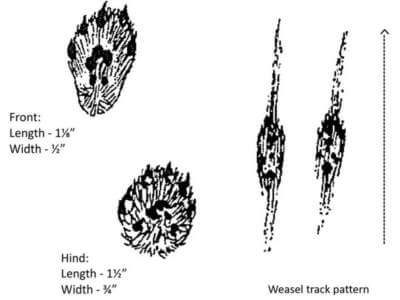
Illustration by Dan Goodman