
Deer Management in Milwaukee, WI
Wisconsin is home to a substantial population of white-tailed deer, estimated at 1.6 million in 2020. According to the Wisconsin DNR, deer-vehicle collisions pose a significant safety risk for drivers, with 15,000 to 19,000 deer killed annually on state roadways. While regulated hunting remains the primary method of population control, it is generally not permitted in most suburban areas.
Keep Deer Out of Your Yard!
Keep deer away with safe, humane deer repellent and deterrents in Milwaukee, Wisconsin.
Give Us a Call Today!Deer Deterrents & Repellents
Habitat modification and repellents are among the most effective ways to keep deer away from gardens and landscaping. Installing fences around flower beds and garden areas can also help prevent deer from feeding on your plants. Additionally, placing posts near trees gives male deer a designated structure to rub their antlers on, protecting the tree bark. At Advanced Wildlife and Pest Control, we use natural deer repellents to safeguard your plants and gardens. Contact us today for effective deer management solutions.
- Deer Identification -
What Does a Deer Look Like?
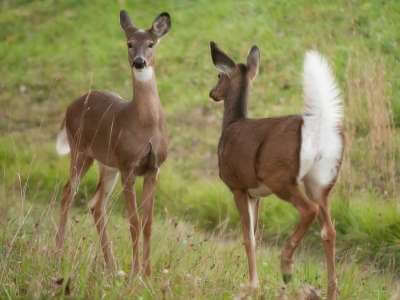
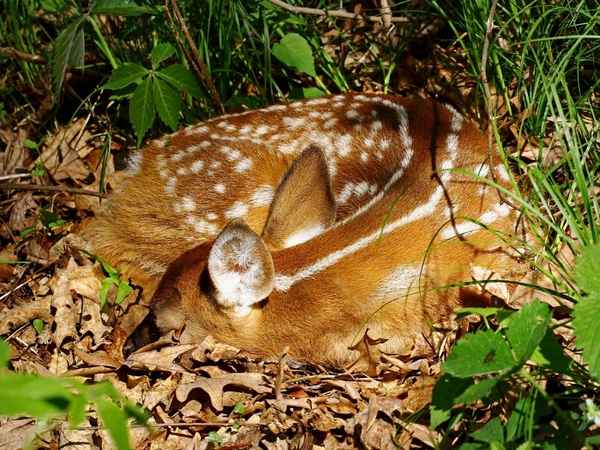
The term “deer” refers to a variety of hoofed animals, including white-tailed deer, elk, and moose. In Wisconsin, the most common species is the white-tailed deer. These deer typically stand 3 to 3½ feet tall. Adult males, or bucks, weigh between 150 and 250 pounds, while adult females, or does, weigh 100 to 150 pounds. Their summer coat ranges from reddish-brown to tan, turning grayish-brown in the winter. White markings appear on the upper throat, belly, inner rump, and underside of the tail. Fawns have reddish coats with white spots, providing camouflage to help them blend into their surroundings. Only males grow antlers, which are shed and regrown each year.
Deer Damage
Deer can cause considerable damage to orchards, nurseries, landscaping, farms, and home gardens through their feeding habits. Male deer also rub their antlers on tree trunks, which can strip bark and, in severe cases, kill the tree. Additionally, white-tailed deer carry deer ticks, which are known to transmit Lyme disease to humans.
Dead Deer Removal Service
If an injured deer wanders onto your property and dies, our wildlife removal professionals can safely and efficiently remove it for you. Please note that there is a fee for this service. Contact us today for prompt assistance!
- Raccoon FAQs -
Frequently Asked Questions
What do deer eat?
The white-tailed deer is an herbivore or plant eater. A deer’s diet changes depending on its habitat and the season. It eats green plants in the spring and summer. In the fall, it eats corn, acorns, and other nuts. In the winter, it eats the buds and twigs of woody plants. In an urban environment, deer may damage plants in vegetable gardens or landscaping.
Where do deer live?
White-tailed deer thrive in various habitats, including forests, farmlands, open fields, and wooded areas. Deer prefer thinly wooded areas near streams and open agricultural areas with easy access to food and protection from predators. Deer are also found in very developed urban areas of Milwaukee, Wisconsin.
When do deer have babies?
White-tailed deer mate from October through January, with the peak occurring in mid-November. Gestation is about 6 to 7 months, with most fawns born in late spring. Fawns can walk and run within a few hours of birth. They are weaned at about six weeks. The fawns are reddish-brown at birth, with white spots that help camouflage them. The mother leaves her fawns well-hidden for hours at a time while she feeds. While waiting for their mother to return, the fawns lay on the ground with their heads and necks stretched out flat, making it harder for predators to find them. Female fawns stay with their mother for two years. Males usually leave after a year.
How long do deer live?
The average lifespan of a white-tailed deer in the wild is about 4 to 6 years. White-tailed deer have several predators, including coyotes, wolves, bears, and bobcats. Unfortunately, many deer die as a result of human interaction, such as road kills and shooting.
What does deer poop look like?
White-tailed deer droppings are dark, cylindrical pellets 1/2 - 1 inch long. The droppings look similar to those of rabbits, but deer will produce much larger deposits of solid scat and clumped pellets.
What do deer tracks look like?
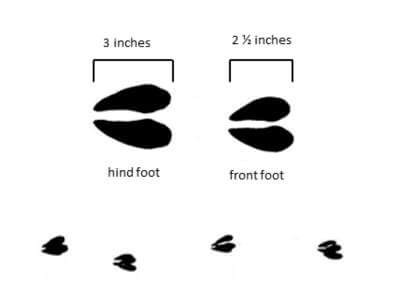
The heart-shaped tracks of white-tailed deer are easy to identify. The deer has two hoofed toes that come to a point at the front. Adult deer tracks measure 1 to 4 inches long and 3/4 to 3 inches wide.